The dream of walking through the historic streets of Rome or sipping coffee in a vibrant Bangkok market while maintaining a high GPA is more attainable than ever. For business students, the shift toward digital connectivity has opened a door that was previously closed: the ability to lead remote projects and manage heavy academic workloads from anywhere in the world. However, transitioning from a traditional classroom to a “global office” requires more than just a passport and a laptop. It requires a strategic approach to time management, a deep understanding of digital collaboration, and the discipline to stay productive when the beach is calling your name.
Traveling while studying is an incredible way to build a global mindset, which is a highly valued trait in the modern corporate world. But let’s be honest: balancing a marketing case study with a flight schedule is stressful. Many undergraduates find that having a reliable support system is the only way to stay afloat. When deadlines pile up and your Wi-Fi is spotty in a remote hostel, the ability to do my assignment online through a platform like Myassignmenthelp can be a lifesaver. It allows you to delegate the heavy lifting of research and formatting so you can focus on your actual travel experiences and project leadership roles without the constant fear of a failing grade.
The Rise of the Student Digital Nomad
The concept of the “Digital Nomad” is no longer reserved for freelance programmers or travel bloggers. Business students are now adopting this lifestyle to gain a competitive edge. By leading remote projects—whether it is a group case study or a virtual internship—you demonstrate to future employers that you possess cultural intelligence and the ability to manage teams across different time zones. These are the exact skills needed to run a multinational corporation.
To succeed, you need to treat your travels like a business operation. This means scouting locations based on their “workability.” A beautiful mountain village might look great on Instagram, but if the upload speeds are slow, your remote project leadership will suffer. Before booking your next destination, always check for co-working spaces or cafes with verified high-speed internet.
Essential Tools for Remote Leadership
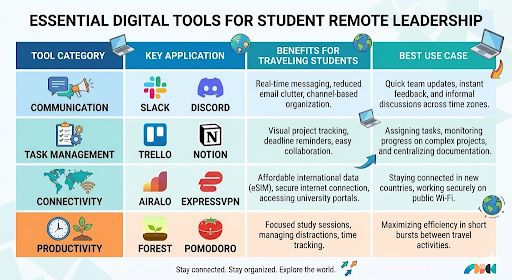
Leading a project from a distance requires a specific tech stack. You cannot rely on physical meetings, so your digital communication must be flawless. Tools like Slack, Trello, and Zoom are the backbone of remote work. As a project leader, your job is to ensure that everyone on your team knows their responsibilities, regardless of where they are sitting.
| Tool Category | Recommended Apps | Benefit for Students |
| Communication | Slack, Discord | Real-time updates without messy email chains. |
| Task Management | Trello, Notion | Visualizing project milestones and deadlines. |
| Connectivity | Airalo, ExpressVPN | Ensuring you stay online and secure in any country. |
| Productivity | Forest, Pomodoro | Staying focused during short study bursts. |
Navigating the Challenges of a Business Degree
Business degrees are notorious for their technical requirements. One day you are analyzing supply chain logistics, and the next, you are diving deep into financial modeling. When you are traveling, these complex subjects can feel overwhelming. It is easy to lose focus on a 50-page business report when you have a sunset tour booked.
In these moments, specialized assistance is crucial. If you find yourself struggling with a complex market analysis or a financial audit while abroad, seeking business assignment help from the experts at Myassignmenthelp ensures that your technical work remains professional and accurate. This allows you to maintain your academic integrity and learn from high-quality examples, even when you don’t have access to your campus library or a face-to-face tutor. By leveraging these resources, you can keep your project leadership on track without letting your individual grades slip.
Mastering the Time Zone Puzzle
One of the hardest parts of leading remote projects is the “Time Zone Gap.” If you are in Bali and your team is in New York, you are living twelve hours ahead of them. This can lead to communication delays that stall project progress.
To lead effectively:
- Establish a “Golden Hour”: Find a two-hour window where everyone is awake and available for a quick sync.
- Work Asynchronously: Document everything. Use shared Google Docs so team members can contribute whenever they are online, reducing the need for constant live meetings.
- Be Proactive: As the leader, send out the agenda for the next day before you go to sleep. This keeps the project moving while you are offline.
Building Your Global Network
The hidden benefit of traveling as a business student is the networking opportunity. Every hostel, co-working space, and airport lounge is filled with professionals from different industries. Don’t just sit in the corner with your headphones on. Talk to the person next to you. You might meet a startup founder in Lisbon or a marketing director in Dubai.
Leading a remote project gives you a great talking point. It shows you are ambitious, organized, and tech-savvy. These “coffee shop meetings” often turn into real-world business connections that can lead to internships or job offers after graduation.
Maintaining Wellness and Avoiding Burnout
It is easy to get “travel burnout” when you are trying to do too much. You want to see every museum, eat at every famous restaurant, and still get an ‘A’ in your Accounting class. This is a recipe for exhaustion.
To stay healthy, follow the “Rule of Three”: Pick three things to accomplish each day. Two should be academic or project-related, and one should be a travel goal (like visiting a specific landmark). This ensures you are making progress in your degree while still enjoying the reason you traveled in the first place. Remember, the goal of being a traveling student is to enrich your life, not to make it more miserable.
Final Thoughts for the Traveling Scholar
Leading remote projects while exploring the globe is a masterclass in management. You are learning to handle logistics, communication, and unexpected hurdles—skills that no textbook can fully teach. By using the right digital tools and knowing when to ask for academic support, you can turn the world into your classroom. Stay organized, stay curious, and keep your goals in sight. The world is too big to stay in one library.
FAQ: Traveling and Studying
1. How do I ensure my professors don’t mind me traveling?
Ans: As long as you meet your deadlines and participate in online discussions, most professors do not care where you are located. Ensure you have a stable internet connection for any live exams or mandatory seminars.
2. Is it expensive to be a student digital nomad?
Ans: Not necessarily. Many countries in Southeast Asia and Central America have a lower cost of living than major university towns in the US or UK. You can often live, eat, and travel for less than the cost of a standard dorm room.
3. What happens if my laptop breaks while I’m abroad?
Ans: Always have a backup plan. Save all your work on the cloud (Google Drive or Dropbox) and know where the nearest “Apple Store” or repair shop is in your current city.
4. How can I stay disciplined without a library environment?
Ans: Create a routine. Wake up at the same time every day and dedicate the first four hours to deep work. Once your tasks are done, you have the rest of the day to explore guilt-free.
5. Can I lead a team effectively if I’ve never met them in person?
Ans: Yes! Video calls help build a personal connection. Make sure to have “non-work” chats for five minutes at the start of meetings to build rapport and trust with your team members.
About The Author
Hi, I’m Mark Hales. As a senior academic consultant at Myassignmenthelp, I specialize in bridging the gap between complex university curriculum and practical, high-quality student submissions. With a background rooted in business management and digital communications, I’ve dedicated my career to helping undergraduates navigate the hurdles of modern higher education.