Hey, coin collectors and history buffs! Have you ever held a 1964 Kennedy Half Dollar in your hand and felt that rush of connection to a pivotal moment in American history? I remember the first time I did—it was tucked away in my uncle’s old cigar box, mixed in with a bunch of other coins from his travels. That shiny silver piece caught my eye, and as I turned it over, I couldn’t help but think about the story behind it. If you’re like me, always on the hunt for that next special find, this guide is for you.
We’ll cover everything from the 1964 Kennedy Half Dollar value to what makes a 1964 Kennedy Half Dollar rare, all while keeping things real and relatable. Let’s get into it.
The Story of the 1964 Kennedy Half Dollar
Picture this: It’s late 1963, and the nation is reeling from the shocking loss of President John F. Kennedy. People were grieving, and there was this collective urge to honor his memory in a lasting way. That’s where the 1964 Kennedy Half Dollar comes in. Congress moved fast—unusually fast for government standards—to replace the Franklin Half Dollar with one featuring JFK. The bill was signed by President Lyndon B. Johnson on December 30, 1963, just weeks after the tragedy.
I think about how coins like this aren’t just metal; they’re time capsules. Holding a 1964 Kennedy Half Dollar takes me back to stories my grandparents shared about watching the news that fateful day in Dallas. It was a tough time, but this coin became a symbol of hope and remembrance. The U.S. Mint had to scramble to produce it, starting strikes in January 1964. By March, the first ones were rolling out to the public.
What struck me most when I started collecting was how popular these were right from the start. Folks lined up at banks to get them, not just for spending but to keep as mementos. That hoarding actually led to a shortage in circulation, which is part of why so many survive in good condition today. If you’ve got one from a family heirloom, you’re not alone—millions were minted, but each one carries that emotional weight.
Also Read: Make1m.com Millionaire Success Journey Guide for You Now
Design Details of the 1964 Kennedy Silver Half Dollar
Let’s talk about what makes the 1964 Kennedy Silver Half Dollar so visually striking. The obverse side features a left-facing portrait of President Kennedy, designed by Gilroy Roberts, who was the Chief Engraver at the Mint. It’s based on a medal he created earlier, but refined for the coin. You’ll notice the fine details in JFK’s hair and the serious yet approachable expression—it’s like he’s looking right at you, reminding us of his charisma.
Flip it over, and the reverse shows a heraldic eagle, claws clutching arrows and an olive branch, symbolizing strength and peace. Frank Gasparro crafted this side, adapting it from the Presidential Seal. Around the edges, you’ve got “UNITED STATES OF AMERICA” and “HALF DOLLAR,” with stars and the motto “E PLURIBUS UNUM.”
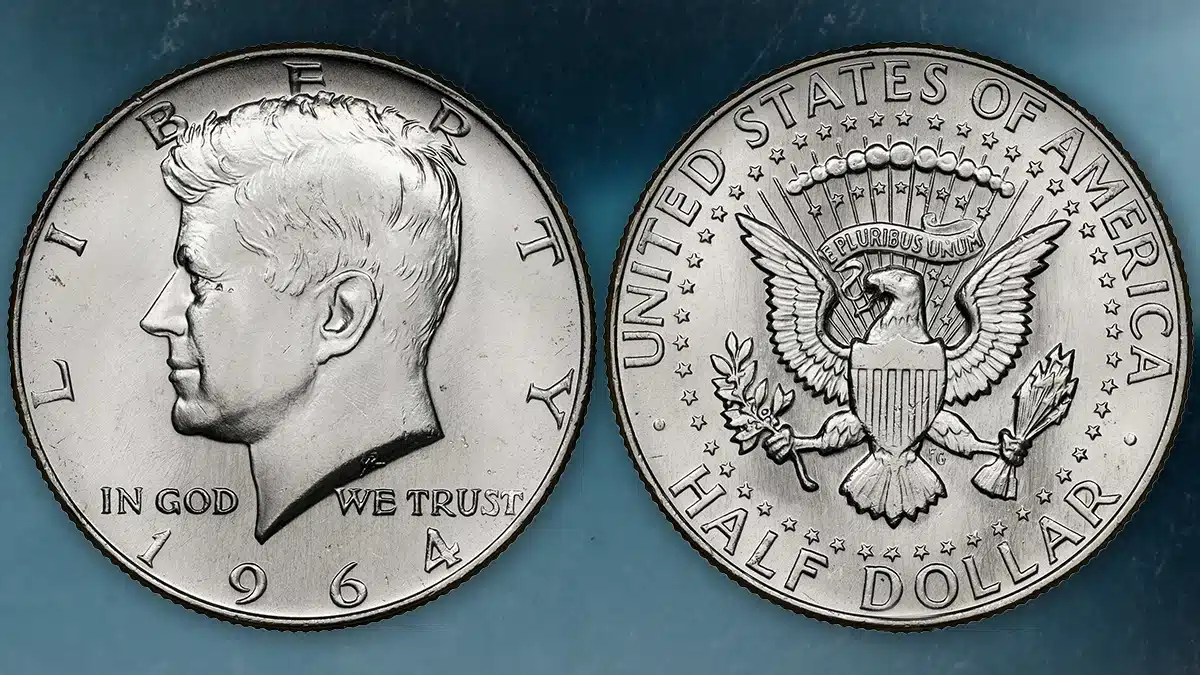
One thing that always gets me is the composition: 90% silver and 10% copper, weighing in at 12.5 grams with a diameter of 30.6 millimeters. That’s why it’s often called the 1964 Kennedy Silver Half Dollar— that high silver content gives it a beautiful luster and heft. Compared to later years when they switched to clad versions, this one feels premium. If you’re new to collecting, handling one versus a modern half dollar is night and day; the silver just sings under the light.
I once compared my 1964 Kennedy Silver Half Dollar to a 1970s version side by side, and the difference in tone and feel was eye-opening. It made me appreciate the craftsmanship even more. The reeded edge adds to the tactile experience, preventing clipping back in the day when silver was king.
How the 1964 Kennedy Half Dollar Was Minted
Diving into the production side, the U.S. Mint cranked out over 273 million at the Philadelphia Mint (no mint mark) and about 156 million at Denver (with a “D” mark). That’s a huge number, which is why the base 1964 Kennedy Half Dollar isn’t super rare in circulated form. But the process wasn’t without hiccups. The Denver Mint, in particular, had some early issues with die preparation, leading to interesting varieties we’ll touch on later.
They used the old Franklin dies as a base but modified them quickly. Proof versions were struck too, with about 3.9 million made in Philadelphia. These were sold in sets, and they’re shinier with mirrored fields—perfect for collectors who want that wow factor.
I recall attending a coin show where a dealer walked me through the minting process using old photos. It was fascinating to learn how the high demand led to extended production runs, even into 1965 for some 1964-dated coins. If you’re wondering about the value of 1964 Kennedy Half Dollar pieces from different mints, Philadelphia ones are generally more common, but Denver can have unique traits that boost appeal.
Also Read: Make1m.com Millionaire Life Profitable Blueprint Growth
What Makes a 1964 Kennedy Half Dollar Rare
Now, to the question on every collector’s mind: What makes a 1964 Kennedy Half Dollar rare? It’s not the mintage alone— with over 400 million produced, most are common. Rarity kicks in with condition, varieties, and errors. For starters, high-grade examples, like those graded MS67 or above by services like PCGS or NGC, are tough to find. The PCGS has only certified about 110 in MS67 or better. That’s because these coins were hoarded but often mishandled over the years.
Then there are the special strikes. The 1964 SMS (Special Mint Set) Kennedy Half Dollars are the holy grail—super rare, with only a handful known. One sold for over $150,000 at auction! These were experimental, with a satin finish, and they’re not your everyday find.
Varieties add another layer. The Accented Hair proof version is a standout—early strikes had heavier lines in JFK’s hair, which Jacqueline Kennedy reportedly didn’t like, so they toned it down. Finding a rare 1964 Kennedy Half Dollar with that accented hair can multiply its value.

Errors are where things get exciting and potentially lucrative. Doubled die obverses, where the design is doubled during die creation, can fetch premiums. Clipped planchets, off-center strikes, or wrong metal errors turn an ordinary coin into a treasure. I once heard from a fellow collector who found a doubled die in pocket change—talk about a lucky day!
If you’re asking yourself, “What makes a 1964 Kennedy Half Dollar rare for me?” Think about your collection’s focus. Maybe it’s proofs, or perhaps errors. Either way, rarity often ties to provenance too—coins with stories or from famous hoards command more.
Breaking Down the 1964 Kennedy Half Dollar Value
Let’s get practical: How much is a 1964 Kennedy Half Dollar worth? It depends on a few key factors. First off, the melt value. With silver prices hovering around $62 per ounce as of December 2025, the 1964 Kennedy Silver Half Dollar value starts at about $22.48 for its silver content alone. That’s the floor— no coin sells below that unless damaged.
For circulated examples, you’re looking at $22 to $25, give or take market fluctuations. But step up to uncirculated, and the 1964 Kennedy Half Dollar value jumps. An MS63 might go for $30-40, while MS65 could be $50-100. Hit MS66, and we’re talking $100-300. The real money is in MS67+, where prices can soar to $500 or more, and gems in MS68 have sold for thousands.
Proofs are another story. A standard PR65 might be $30-50, but climb to PR69, and it’s $200+. The Accented Hair variety? Those in high grades can hit $1,000 to $10,000 or more.
Don’t forget the SMS versions—their 1964 Kennedy Silver Half Dollar value is off the charts, often six figures. If you have one, get it authenticated immediately!
I always tell new collectors: Condition is king. A scratched-up coin might only get melt, while a pristine one could fund your next vacation. Check recent auction results on sites like Heritage or eBay for the latest on value of 1964 Kennedy Half Dollar pieces.
Also Read: Make1m.com Luxury Blueprint: Step-by-Step Wealth Framework
Rare Varieties and Errors in the 1964 Kennedy Half Dollar
Zooming in on those special finds, let’s explore rare 1964 Kennedy Half Dollar varieties and errors. The Doubled Die Obverse (DDO) is a fan favorite—look for doubling on “LIBERTY,” the date, or “IN GOD WE TRUST.” Philadelphia minted some with this, and they can add 20-50% to the value in mid-grades, up to hundreds in high condition.

Denver had its share too, with some DDOs and even tripled punches. Other errors include broadstrikes (oversized coins), die cracks, or laminations where the metal splits. A clipped planchet, where part of the edge is missing, can make a coin unique and valuable.
The Accented Hair proofs are a variety, not an error, but they’re rare because production was limited before the design tweak. About 1-2% of proofs are this type, making them sought after.
I have a personal soft spot for errors—my first big find was a 1964 with a minor clip. It wasn’t worth a fortune, but the thrill of spotting it in a bulk lot? Priceless. If you’re hunting, use a loupe and compare to known examples online.
Grading Your 1964 Kennedy Half Dollar
Grading can feel intimidating, but it’s key to understanding the value of 1964 Kennedy Half Dollar coins. Services like PCGS and NGC use a 70-point scale: 1-59 for circulated, 60-70 for mint state (MS) or proof (PR).
For circulated: Good (G4) to Almost Uncirculated (AU58). Wear on high points like JFK’s cheek or the eagle’s feathers drops the grade.
Mint state: No wear, but marks from bagging or handling affect it. MS60-62 are average, with bag marks; MS63-65 better luster; MS66+ exceptional.
Proofs get CAM (Cameo) or DCAM (Deep Cameo) for contrast between frosted devices and mirrored fields.
I suggest sending valuable coins for professional grading—it protects them and boosts resale value. Once, I thought I had an MS67, but it graded MS65 due to a tiny hit. Lesson learned: Eyes can deceive, but slabs don’t lie.
Also Read: Make1m.com Millionaire Lifestyle Secrets for Fast Success
Where to Buy and Sell Your 1964 Kennedy Half Dollar
Ready to add a 1964 Kennedy Half Dollar to your collection? Start with reputable dealers like APMEX, JM Bullion, or local coin shops. Online auctions on eBay work, but watch for fakes—always buy graded if possible.
For selling, the same spots, plus auction houses for high-end pieces. Know your 1964 Kennedy Half Dollar value first—use price guides like the Red Book or online charts.
A tip from my experience: Build relationships with dealers. They often give better deals to regulars. And if you’re selling, time it with silver highs for max profit.
Collector Stories and Tips
Over the years, I’ve chatted with so many folks about their 1964 Kennedy Half Dollar finds. One guy told me he inherited a roll from his dad, who got them the day they released. Turned out one was an Accented Hair proof—jackpot!
Another shared the pain of buying a “rare” coin that was counterfeit. Ouch. To avoid that, learn the specs: Weight should be exact, silver ring when dropped.
For storage, use flips or albums away from humidity. And join clubs like the ANA for networking—it’s where I met mentors who shaped my hobby.
If you’re just starting, don’t chase rarities first. Build with common 1964 Kennedy Silver Half Dollar pieces to learn, then upgrade.
Wrapping Up Your Journey with the 1964 Kennedy Half Dollar
There you have it—a deep look at the 1964 Kennedy Half Dollar, from its heartfelt origins to today’s market values. Whether you’re eyeing the 1964 Kennedy Half Dollar value for investment or the emotional pull of history, this coin has something for everyone. I’ve shared my stories; now go create yours. Hunt that rare 1964 Kennedy Half Dollar, and who knows? You might strike gold—or silver, in this case.
For more useful articles, visit my website: Make1M.us.