
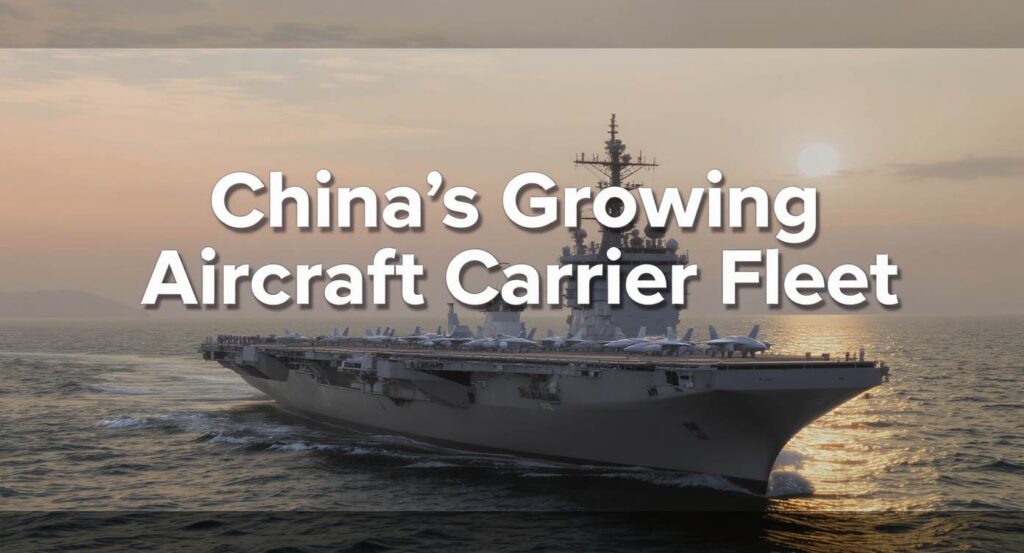
Hey folks, let’s talk about something that’s been keeping military watchers and everyday folks like us on our toes—China’s growing aircraft carrier fleet. As someone who’s followed global navies for years, I have to say, the pace at which China is building up its blue-water capabilities feels like watching a thriller unfold in real time. You might be sitting there, scrolling through news feeds, wondering what this means for the world, especially with tensions simmering in places like the South China Sea. Well, pull up a chair because I’m breaking it down with some expert takes, straight facts, and a bit of my own perspective from years of digging into this stuff.
Back when I first got interested in naval history—must have been around 2012, right after the Liaoning hit the waves—I remember thinking, “This is just the start.” China was playing catch-up then, but fast-forward to today, December 2025, and their fleet is no longer in the shadows. With the recent commissioning of the Fujian, China’s growing aircraft carrier fleet now stands at three operational ships, each more advanced than the last. It’s not just about numbers; it’s about projecting power far from home shores, and that’s got everyone from policymakers to armchair strategists buzzing.
In this post, I’ll walk you through the history, the current lineup, what’s coming next, and what experts are saying about the bigger picture. We’ll keep it real, no hype—just solid analysis to help you make sense of it all. If you’ve ever worried about how this shifts balances in the Pacific or what it means for international stability, stick around. We’re in this conversation together.
Must Read: British Airways Gatwick New York Suspension: Disruption Now.
The Evolution of China’s Aircraft Carrier Program
China’s journey into aircraft carriers didn’t happen overnight. It started as a dream in the late 20th century, when the People’s Liberation Army Navy (PLAN) realized that to protect its interests abroad, it needed more than coastal defenses. Think about it: back in the 1970s, while the U.S. was sailing supercarriers around the globe, China was studying old hulls just to figure out the basics.
Early Steps and Learning Curves
The real kickoff came in the 1980s when China bought decommissioned carriers from other nations, not to sail them, but to tear them apart and learn. For instance, they acquired the Australian HMAS Melbourne in 1985 and used it to reverse-engineer catapult systems. That hands-on approach was smart—it’s like taking apart a bike to build your own. By the 1990s, they snapped up Soviet-era ships like the Minsk and Kiev, turning them into floating museums while quietly absorbing the tech.
I have a personal story here: during a trip to China in the early 2000s, I visited one of those theme parks built around the Minsk. Standing on that deck, feeling the massive structure, it hit me how determined they were. It wasn’t just scrap metal; it was a classroom for future engineers. Fast forward, and by 2002, they had the incomplete Varyag from Ukraine, which became the foundation for their first carrier. This phase was all about trial and error, building expertise from the ground up.
Building Momentum in the 21st Century
By the 2010s, China shifted from studying to constructing. The Central Military Commission greenlit pilot training in 1987, but it took decades to bear fruit. Reports from that era show negotiations with countries like Spain and France for designs, though nothing panned out directly. Instead, they focused inward, setting up training facilities and mock decks. In 2011, a land-based test site in Wuhan started simulating carrier operations, which was a game-changer.
What strikes me is how patient they were. You know that feeling when you’re learning a new skill, like playing guitar, and it takes forever to get good? That’s China with carriers—they invested in the long game, and now it’s paying off as their growing aircraft carrier fleet expands.
Must Read: 2024 United States House of Representatives Elections: Guide.
Breaking Down China’s Current Fleet
At the heart of China’s growing aircraft carrier fleet are three ships, each representing a step up in technology and ambition. Let’s look at them one by one, because understanding the details helps cut through the noise.
Liaoning: The Trailblazer
The Liaoning, or Type 001, was China’s entry ticket into the carrier club. Originally the Soviet Varyag, bought incomplete in 1998 and refitted in Dalian, it was commissioned in 2012. With a displacement of about 55,000 tons, it uses a ski-jump ramp for short take-off but arrested recovery (STOBAR) operations. That means planes like the J-15 fighter launch with a boost from the ramp but land with wires.
I’ve always thought of the Liaoning as the reliable old truck in your garage—it’s not flashy, but it gets the job done. Homeported at Yuchi Naval Base, it’s been on deployments signaling China’s reach, like recent sails near Japan that raised eyebrows. If you’re concerned about regional flashpoints, this ship’s movements are a reminder of how carriers can flex muscle without firing a shot.
Shandong: Refining the Formula
Next up is the Shandong, Type 002, China’s first fully home-built carrier. Laid down in 2013, launched in 2017, and commissioned in 2019, it weighs in at around 70,000 tons. It sticks with STOBAR but improves on the Liaoning with a 12-degree ski-jump (versus 14 degrees), a bigger hangar for more aircraft, and a sleeker island superstructure with advanced radars.
Picture this: if Liaoning was the prototype, Shandong is the upgraded model with better handling. Based at Yulin Naval Base, it’s been active in exercises, including joint ops with the Liaoning beyond the second island chain. For folks worried about Taiwan or the East China Sea, these dual-carrier groups show China’s ability to coordinate big forces, as the 100-ship surge reported recently.
Fujian: Entering the Big Leagues
Now, the star of the show—the Fujian, Type 003, commissioned just last month on November 5, 2025, in Sanya with President Xi Jinping presiding. At over 80,000 tons, it’s the largest non-U.S. carrier and switches to catapult-assisted take-off but arrested recovery (CATOBAR) with electromagnetic catapults, like those on U.S. Ford-class ships.
This is a huge leap. The EM cats allow heavier loads and more plane types, including stealthy J-35 fighters and KJ-600 early-warning aircraft. I remember tracking its sea trials earlier this year; it felt like watching a kid graduate college. Experts say it tilts the balance in the South China Sea, though it’s still the only truly modern one in the fleet.
With these three, China’s growing aircraft carrier fleet can now field multi-carrier groups, as seen in recent West Pacific ops amid U.S. deployments.
What’s Next for China’s Growing Aircraft Carrier Fleet?
Looking ahead, China’s plans are ambitious, aiming for five or six carriers by the 2030s. That’s not just talk; construction is underway.
The Type 004 and Nuclear Ambitions
The fourth carrier, Type 004, is being built at Dalian Shipyard, possibly starting in 2024. New satellite images from February 2025 suggest it could be nuclear-powered, with integrated electric propulsion for even better catapults. At around 120,000 tons, it’d rival U.S. supercarriers.
You might be thinking, “Does this mean endless patrols?” Nuclear power allows that, extending range without refueling. Renovations at the Wuhan test site in September 2025 hint at more to come. If you’re anxious about arms races, this escalation is worth watching.
Long-Term Projections
Beyond Type 004, expect more indigenous designs. Aircraft like the J-35 stealth fighter, in service since 2025, will boost lethality. China’s growing aircraft carrier fleet isn’t stopping; it’s about sustaining a presence in key areas.
Must Read: United Airlines Flight Ua770 Emergency Diversion Alarming
Strategic Implications of China’s Naval Expansion
China’s growing aircraft carrier fleet isn’t just hardware—it’s strategy. It pressures neighbors and challenges U.S. dominance.
Tensions in the Pacific
Recent moves, like the Liaoning’s unique routes near Japan, amp up friction. With over 100 ships coordinated in December 2025, it’s clear they’re practicing for scenarios around Taiwan. If you live in the region or follow geopolitics, this buildup addresses your concerns about stability—it’s a deterrent, but also a spark.
Japan’s watching warily, especially with Fujian’s air wing outmatching their naval fighters. China warns against interference, emphasizing self-defense.
Global Reach and Alliances
On a broader scale, this fleet extends influence to the Indian Ocean and beyond. It counters U.S. carriers, like the F-35-equipped ones sent to the West Pacific. For you and me, it means rethinking alliances—will partners step up, or is this a new normal?
Expert Insights on China’s Carrier Capabilities
Experts agree: China’s growing aircraft carrier fleet is impressive but has gaps. Numbers don’t equal dominance yet; experience matters. Retired officers predict rapid growth, but training and logistics lag U.S. levels.
One analyst noted Fujian’s commissioning as a milestone in Xi’s modernization drive. It’s about quality now—EM cats allow advanced ops, but full integration takes time.
How Does China’s Fleet Compare to the US?
The U.S. has 11 supercarriers, mostly nuclear, with decades of ops. China’s three are catching up in tech, but not in quantity or experience. Fujian matches Ford-class in some ways, but the PLAN’s fleet is smaller overall.
That said, in a localized conflict, China’s growing aircraft carrier fleet could dominate. Experts warn against underestimating; it’s a race where China is sprinting.
Wrapping up, China’s growing aircraft carrier fleet is a story of ambition and progress. From my vantage point, it’s fascinating yet sobering—reminds us how tech and strategy shape our world. What do you think? Drop a comment; let’s keep the chat going.
For more useful articles, visit my website: Make1m.us.